Introduction
Wallets are among the easiest personal belongings to misplace. Unlike larger bags or backpacks, a wallet can disappear into a jacket pocket, under furniture, inside a vehicle, or somewhere in a busy public place without immediately being noticed. Because wallets often contain identification cards, payment cards, access cards, and other important items, losing one can create more than a simple inconvenience.
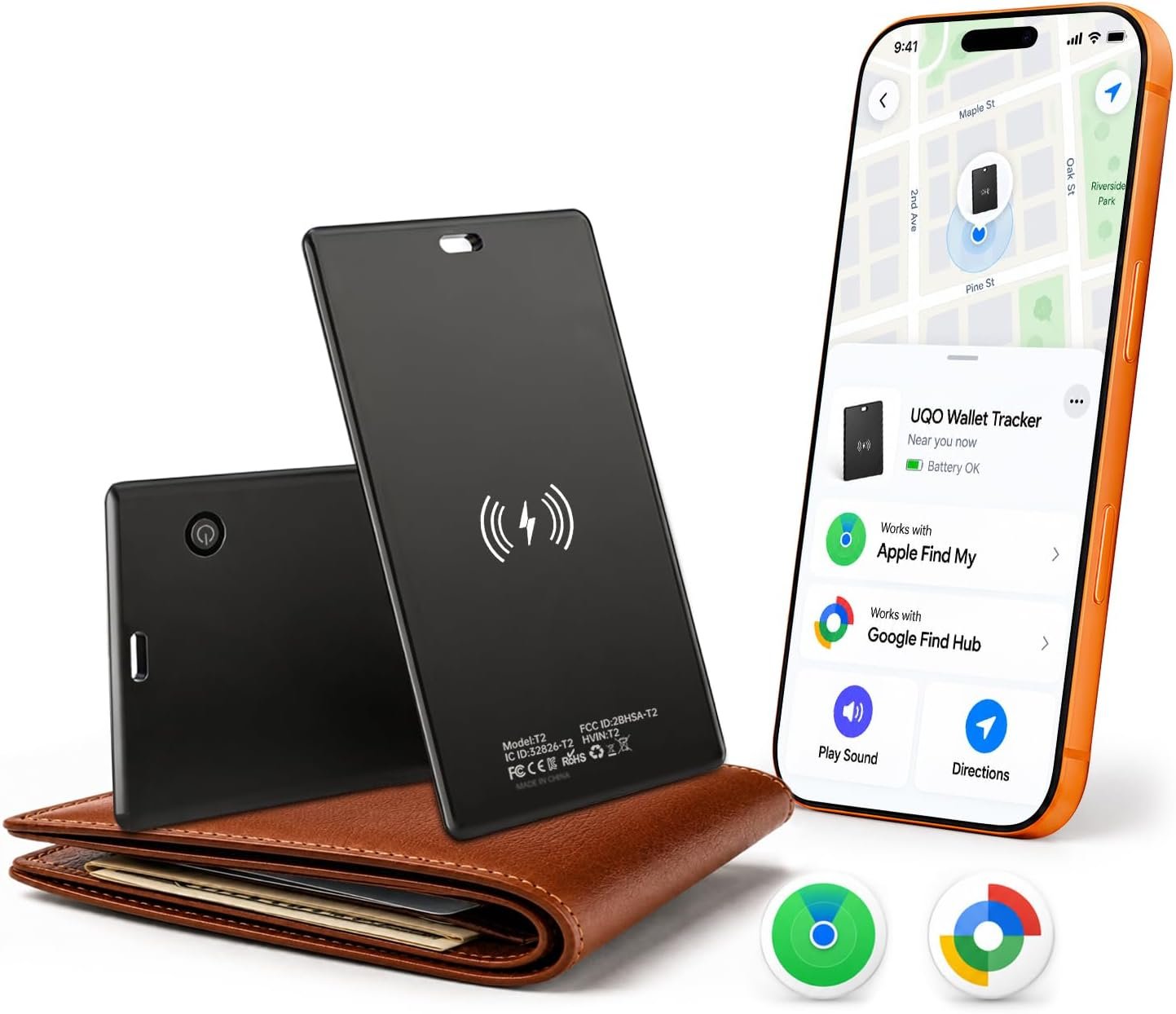
A wallet tracker card is designed to add a digital way to locate the wallet. Instead of attaching a conventional round Bluetooth tracker to the outside of a wallet, a tracker card uses a thin, card-shaped design intended to fit inside a wallet alongside other cards.
The Wallet Tracker Card, Works with Apple Find My or Google Find Hub, available through the supplied Amazon listing, is designed around this concept. Its main purpose is to provide an item-finding function while fitting into a space normally occupied by a credit card, driver’s license, membership card, or similar item.
One of the notable aspects of this category is support for both major smartphone ecosystems. Depending on the configuration and compatible device, a tracker card can work with Apple’s Find My service or Google’s Find Hub. This makes the category relevant to people who use different types of smartphones or who may switch between iOS and Android over time.
However, it is important to understand what a wallet tracker card actually does. A Bluetooth item tracker is not the same as a standalone GPS device. It normally communicates with a phone through Bluetooth when nearby and can use a broader finding network to help determine a location when the item is farther away. The availability and behavior of these functions depend on the platform, phone, network environment, and current software.
This guide explains how a wallet tracker card works, where it can be useful, what to consider before using one, and how this type of device compares with other methods of tracking personal belongings.
Key Features
Card-shaped design for wallets
The most obvious characteristic of a wallet tracker card is its physical shape.
Traditional item trackers often use a small circular or square housing designed to attach to a key ring or strap. A card-style tracker takes a different approach. Its flat form is intended to slide into a wallet without requiring a bulky attachment.
This design can be especially relevant for people who prefer to keep their wallet relatively organized. Rather than adding a tracker to the outside of the wallet, the card can be positioned between other cards or in a dedicated wallet compartment.
The exact thickness of a particular tracker card should always be checked against the current product listing. Even relatively thin electronic accessories can make a minimalist wallet feel different when combined with several existing cards.
Apple Find My compatibility
The product is presented as compatible with Apple’s Find My ecosystem.
Find My is Apple’s built-in platform for locating supported devices and compatible accessories. When an item tracker is properly associated with the service, its location can be managed through the Find My environment rather than through a completely separate tracking application.
For an iPhone user, this can make the tracker easier to incorporate into an existing device-finding routine.
The exact functions available can depend on the Apple device, iOS version, accessory certification, and current Find My capabilities. Compatibility should therefore be confirmed against the current product listing and Apple’s current requirements before setup.
Google Find Hub compatibility
The product is also described as working with Google Find Hub.
Google Find Hub is designed to help Android users locate compatible devices and tracker accessories. It can provide a way to manage supported Bluetooth trackers through Google’s device-finding ecosystem.
Google explains that Find Hub can use a crowdsourced network of Android devices to help locate compatible offline items. When a tracker is away from its owner’s phone, participating devices may detect it and securely contribute location information to the finding system. (support.google.com)
This network-based approach is important because it allows a Bluetooth tracker to potentially remain useful even when the owner’s phone is no longer within direct Bluetooth range.
Bluetooth connectivity
At its core, a wallet tracker card is a Bluetooth-based item finder.
When the wallet is nearby, the phone can communicate with the tracker through Bluetooth. Depending on the platform and accessory capabilities, the user may be able to initiate a sound or otherwise identify the tracker’s location.
Bluetooth is particularly useful for everyday situations where the wallet is somewhere close but its exact location is unknown.
For example, a wallet could be inside a coat pocket, underneath a car seat, behind a piece of furniture, or inside another bag. A tracker can reduce the need to search every possible location manually.
Bluetooth range is not a fixed guarantee, however. Walls, furniture, vehicles, other electronics, and environmental interference can affect communication.
Network-assisted finding
The larger advantage of modern tracker ecosystems is that they can potentially assist with finding an item outside direct Bluetooth range.
If a wallet is left somewhere and the owner’s phone cannot communicate with the tracker directly, compatible devices belonging to other participants in the relevant network may detect the tracker.
Google’s documentation describes Find Hub’s crowdsourced network as a method for helping users locate compatible offline items through participating Android devices. (support.google.com)
This does not mean that the tracker independently transmits its location from anywhere in the world. Instead, the surrounding environment needs to provide opportunities for the tag to be detected.
A wallet left in a busy shopping center may have more opportunities for network detection than one left in a remote location with few compatible devices nearby.
Wallet-focused form factor
A card-shaped tracker is designed around the specific physical constraints of a wallet.
This is different from a general-purpose tracker that may need a key ring, adhesive mount, loop, or protective holder.
The form factor can make the tracker suitable for people who want their tracking accessory to remain mostly hidden inside the wallet. It can also reduce the chance of accidentally leaving the tracker behind when moving the wallet between bags.
Audible finding
Many Bluetooth trackers use sound to help locate nearby items.
When supported by the tracker and platform, an audible alert can be useful when the phone indicates that the wallet is nearby but its exact physical position is unclear.
For example, a wallet may be somewhere in a bedroom or living room, but visual searching may still take time. A sound-based alert can provide another clue.
The practical usefulness of an audible feature depends on the volume, surrounding noise, distance, and whether the wallet is covered by clothing, cushions, or other objects.
Battery considerations
Wallet tracker cards use internal batteries to power their Bluetooth electronics.
The battery design varies between products. Some tracker cards use replaceable batteries, while others use rechargeable or sealed rechargeable designs.
This distinction is worth considering before purchase because it affects long-term maintenance.
A replaceable-battery model can generally continue operating after a battery change, while a rechargeable model requires periodic charging. A sealed battery may require a different replacement process or eventually require replacement of the tracker itself.
Because the supplied product listing should be treated as the current source for the exact battery specification, users should check the latest Amazon listing for battery type, expected operating time, charging method, and replacement instructions.
How It Can Be Used
Locating a wallet at home
The most straightforward use is finding a wallet somewhere inside the home.
People often put wallets down temporarily after returning from work, shopping, or travel. A wallet might end up on a kitchen counter one day and inside a bedroom or jacket pocket the next.
With a tracker card inside the wallet, the user can use the relevant Apple or Google finding service to help determine where it is.
If the tracker is within Bluetooth range, the phone may be able to establish a direct connection and activate the tracker’s finding features.
Finding a wallet left in a vehicle
Cars are another common place for misplaced wallets.
A wallet can slide underneath a seat, fall between the center console and a seat, or remain in a jacket left inside the vehicle.
If the tracker is still within Bluetooth range, it can help confirm that the wallet is nearby.
This can be particularly useful when someone knows the wallet is probably in the vehicle but cannot see it immediately.
Keeping track of a wallet during travel
Travel can increase the number of situations in which a wallet may be misplaced.
Airports, hotels, restaurants, rental cars, public transportation, and tourist attractions all involve frequent movement and temporary placement of personal belongings.
A tracker card provides an additional way to locate the wallet if it is accidentally left behind.
It should not, however, be treated as a replacement for normal travel precautions. Important identification and payment cards should still be protected carefully, and travelers should follow appropriate procedures if a wallet is lost.
Finding a wallet in a public location
If a wallet is left in a café, office, store, or other public location, a finding network may potentially provide useful location information.
The result depends on whether compatible devices encounter the tracker and whether the relevant platform can update the item’s location.
Network-assisted finding is therefore best understood as an additional recovery aid rather than a guaranteed tracking service.
Using the tracker with another small personal item
Although the card format is designed primarily for wallets, its flat shape can potentially be useful with other belongings that have a suitable compartment.
For example, a tracker card might fit inside a document organizer, passport holder, travel pouch, laptop sleeve, or another flat accessory.
The suitability depends on the dimensions and construction of the item.
Organizing multiple important belongings
Some people may want separate tracking accessories for several categories of belongings.
A wallet tracker card can be part of a larger personal organization system alongside other trackers designed for keys, bags, luggage, or electronic equipment.
Using clear names in the corresponding Apple or Google finding platform can make multiple trackers easier to distinguish.
For example, users could label different items according to their actual purpose rather than relying on generic tracker names.
Who It May Be Suitable For
People who frequently misplace wallets
The most obvious audience is anyone who regularly spends time searching for their wallet.
A tracker cannot prevent the wallet from being misplaced, but it can provide another method for locating it.
The card format also keeps the tracking device physically associated with the wallet.
Travelers
Frequent travelers may find the concept useful because wallets are constantly moved between airports, hotels, vehicles, restaurants, and other locations.
A tracker provides another layer of awareness without requiring a large device attached to the outside of the wallet.
Minimalist wallet users
People who prefer a flat wallet may appreciate the card-shaped format, provided that the tracker does not add more thickness than they are comfortable carrying.
The physical dimensions should be checked carefully because minimalist wallets have limited space.
iPhone users
The Apple Find My compatibility makes this type of tracker relevant to people already using Apple’s device-finding ecosystem.
The advantage of using an ecosystem that is already part of the phone’s software environment is that users may not need to learn an entirely separate tracking platform.
Android users
Android users can consider the Google Find Hub functionality.
Google has continued expanding its Find Hub ecosystem to support compatible tracker accessories and network-assisted finding. (support.google.com)
Users should still verify that their specific Android device and software version meet the current requirements.
Households with different phone ecosystems
A dual-platform tracker category can also be relevant to households where some people use iPhones and others use Android phones.
However, compatibility details differ between products, so the exact setup process should be confirmed before assuming that one tracker can be actively managed by multiple phones across both platforms at the same time.
Important Things to Consider
Understand the difference between Bluetooth and GPS
One of the most important considerations is the distinction between a Bluetooth item tracker and a GPS tracker.
A Bluetooth tracker generally does not contain the same type of cellular hardware used by standalone GPS tracking equipment.
Instead, it communicates over Bluetooth and can participate in a larger finding network.
This means that a tracker card should not be expected to provide a continuously updated location independently of nearby phones.
Network availability affects remote finding
The effectiveness of network-assisted finding depends partly on how many compatible devices are in the surrounding area.
A tracker in a crowded city may encounter many compatible devices. A tracker in a rural or isolated environment may have fewer opportunities for detection.
This is an inherent characteristic of crowdsourced Bluetooth finding networks.
Check platform compatibility before setup
Although the product is marketed around compatibility with Apple Find My and Google Find Hub, users should check their phone’s operating system and the latest platform requirements.
Software requirements can change over time.
It is also important to understand whether the specific tracker has to be reset or removed from one ecosystem before being paired with another.
Consider the physical thickness
Wallet tracker cards are designed to be thin, but “card-shaped” does not necessarily mean identical to a standard payment card.
A tracker may have electronics, a battery, speakers, and other components inside its housing.
People using a very slim wallet should therefore consider the tracker’s dimensions alongside the number of cards they normally carry.
Battery management matters
The tracker needs sufficient power to remain useful.
Users should pay attention to battery status where the platform provides that information. Google explains that Find Hub can display battery information for supported tracker accessories. (support.google.com)
If the battery becomes critically low, finding functionality may eventually stop working.
Do not depend on a tracker for high-stakes recovery
A tracker should be treated as a supplemental tool.
If a wallet contains important identification, financial cards, keys, or other sensitive items, users should still maintain appropriate security practices.
For example, payment cards should be monitored through the relevant financial institution, and lost identification should be reported according to applicable procedures.
A tracker can potentially help locate the physical wallet, but it does not protect the information contained inside it.
Privacy and unwanted tracking
Bluetooth tracking technology comes with privacy considerations.
Modern Apple and Google ecosystems include protections intended to help people identify unknown trackers that may be traveling with them.
Google describes unknown-tracker alerts as a safety feature designed to notify users when an unfamiliar tracker may be moving with them. (support.google.com)
Google also states that Find Hub should not be used to track people or property without appropriate knowledge and consent. (support.google.com)
A wallet tracker should therefore be used for legitimate purposes such as locating one’s own belongings or tracking shared property with appropriate consent.
Sound may not always be easy to hear
An audible alert is useful when the wallet is nearby, but sound can be affected by its surroundings.
If the wallet is buried under clothing, trapped between furniture, inside a closed vehicle, or surrounded by loud environmental noise, the alert may be difficult to hear.
The sound feature should therefore be considered one finding method rather than the only one.
Comparison of General Tracker Categories
Wallet tracker cards
Wallet tracker cards prioritize a flat physical design.
They are intended to fit into wallets and other thin compartments. Their main advantage is physical convenience for this particular use case.
The trade-off is that a card-shaped tracker may not be as convenient to attach to keys or luggage without an appropriate holder.
Round or square Bluetooth trackers
Traditional Bluetooth trackers are often designed around a small round or square enclosure.
These trackers can be convenient for key rings, backpacks, luggage straps, and other objects where an attachment loop is useful.
Their shape may be less suitable for a minimalist wallet, but more flexible for objects that need external attachment.
GPS/cellular trackers
GPS/cellular devices are designed for situations where more independent location tracking is required.
They can communicate using cellular networks and may provide different types of location information.
However, they can require larger batteries, charging, mobile connectivity, subscriptions, or additional setup.
For a wallet, the extra hardware may not be practical compared with a thin Bluetooth tracker.
Smartphone-based location services
Some users may simply rely on their phone’s own location history or other digital services.
These systems are useful for locating the phone itself or understanding where a person has been, but they do not automatically attach a location capability to a physical wallet.
A dedicated tracker bridges that gap by giving the wallet its own identifiable electronic accessory.
Smart wallets with built-in tracking
Some wallets are manufactured with tracking hardware integrated directly into the wallet.
This can create a cleaner physical design because the tracker is part of the wallet rather than a separate card.
The disadvantage is that changing wallets may mean losing the integrated tracking feature.
A separate tracker card can be moved between compatible wallets, which may provide more flexibility.
Setting Up a Wallet Tracker Card
The setup process depends on whether the tracker is being configured through Apple Find My or Google Find Hub.
For Android users, Google recommends ensuring that the appropriate Google account is active and that features such as Bluetooth, Location, and Find Hub are enabled. Offline-finding settings can also affect how compatible devices are located. (support.google.com)
For Apple users, the tracker should be configured according to the instructions supplied with the accessory and the current Find My process.
After pairing, give the tracker a clear name.
Instead of using a generic name such as “Item,” consider names like:
- Wallet
- Travel Wallet
- Work Wallet
- Card Holder
A clear label becomes particularly helpful when managing more than one tracker.
Once setup is complete, test the tracker while the wallet is nearby. Confirm that the phone recognizes it and that the available finding functions work as expected.
Testing before an actual loss also provides an opportunity to become familiar with the interface.
Practical Ways to Get More Value From a Wallet Tracker
Establish a regular wallet routine
A tracker works best as part of an organized routine rather than as a replacement for one.
For example, placing the wallet in the same location whenever you arrive home reduces the chance of losing it in the first place.
The tracker then serves as an additional safety layer.
Check the battery periodically
Do not wait until the tracker fails before thinking about battery condition.
If the platform displays battery information, check it occasionally and replace or recharge the tracker according to the manufacturer’s instructions.
Keep the wallet’s digital information secure
A physical tracker can help locate the wallet, but it does not protect the payment cards and identification inside it.
Users should also make sure that financial apps, accounts, and devices are protected with appropriate authentication.
Test network functionality occasionally
It can be useful to confirm that the tracker still appears correctly in the appropriate finding service.
This is particularly important after changing phones, changing accounts, resetting the device, or updating operating systems.
Frequently Asked Questions
What is a wallet tracker card?
A wallet tracker card is a thin electronic item tracker designed to fit inside a wallet. It typically uses Bluetooth to communicate with a compatible smartphone and may use a larger device-finding network to help locate the item when it is outside direct Bluetooth range.
Does this type of tracker work with iPhone?
The supplied product is described as compatible with Apple Find My. Users should verify the current listing and compatibility requirements before setup.
Does it work with Android?
The supplied product is also described as compatible with Google Find Hub. Android compatibility depends on the device and current Google requirements.
Is a wallet tracker card a GPS device?
Generally, no. A wallet tracker card in this category is a Bluetooth-based item finder rather than an independent cellular GPS tracker.
Can it find a wallet that is far away?
Potentially, if the relevant Apple or Google finding network detects the tracker. The result depends on participating devices and the environment surrounding the wallet.
There is no guarantee of continuous or immediate location updates.
Does the tracker need Bluetooth?
Bluetooth is a fundamental part of the tracker’s communication system. The phone and tracker use Bluetooth for nearby interaction, while the broader finding network can provide assistance when the tracker is outside direct range.
Can it prevent wallet theft?
No. A tracker does not physically prevent theft.
It may help provide location information about a misplaced or separated wallet, but it should not be treated as an anti-theft device.
Can someone else track my wallet?
Access depends on how the tracker is registered and how the relevant Apple or Google platform handles sharing and account access.
Users should keep their accounts secure and only share tracking access with trusted people when appropriate.
Can a wallet tracker be used to track another person?
It should not be used to secretly monitor another person. Tracking technology should be used responsibly and with appropriate knowledge and consent.
Google specifically states that Find Hub should not be used to track people or property without appropriate consent. (support.google.com)
What happens when the tracker battery runs out?
The tracker may stop communicating until its battery is replaced or the device is recharged, depending on the particular model.
The battery type and maintenance procedure should be confirmed from the current product documentation.
Will the tracker work everywhere?
The tracker may function in many locations, but its effectiveness depends on Bluetooth range, compatible devices, platform support, battery condition, and network availability.
A crowded urban environment can provide more opportunities for network-assisted detection than a remote area.
Can I put the tracker in a passport holder?
Potentially, if the holder has enough room and the tracker is compatible with the physical design of the holder. The dimensions should be checked before using it with a particular accessory.
Can I use it outside a wallet?
The card shape makes it especially suitable for wallets, but it may also fit other flat compartments such as document holders, travel organizers, or certain bags.
The practical limitation is how securely the card can be positioned.
Conclusion
A wallet tracker card provides a simple way to add digital finding capabilities to one of the most frequently carried personal belongings.
Instead of relying on a traditional round tracker or an external attachment, its card-shaped design is intended to fit naturally inside a wallet. The Wallet Tracker Card, Works with Apple Find My or Google Find Hub is therefore relevant to users who want wallet-focused tracking while using either of the two major smartphone ecosystems.
The main concept is straightforward: Bluetooth provides nearby communication, while Apple Find My or Google Find Hub can provide broader network-assisted finding capabilities when the wallet is outside direct Bluetooth range. Google’s documentation explains that Find Hub can use participating Android devices to help locate compatible offline items, while platform safety systems are designed to address unwanted tracker detection and privacy concerns. (support.google.com)
At the same time, realistic expectations are important. A wallet tracker card is not a standalone GPS system, remote finding depends on network conditions, Bluetooth performance varies by environment, and battery maintenance remains necessary. The tracker also cannot replace normal financial and personal-security procedures when a wallet is lost.
For people who frequently carry a wallet and want an additional way to locate it, a thin tracker card can fit naturally into an everyday organization system. The most useful approach is to configure it correctly, test its finding functions before an emergency occurs, keep the battery maintained, and understand how the chosen Apple or Google ecosystem handles tracking and privacy.
Leave a Reply